By Anne Blythe
Mary Otto was a reporter at The Washington Post almost two decades ago when she came across the story of a Maryland boy whose lack of access to routine dental care would expose a broken oral health system.
Deamonte Driver was just 12 years old in February 2007 when he died from a brain infection. The cause? An untreated tooth abscess that could have been prevented had his mother not encountered so many barriers to getting her son dental care.
Deamonte’s untimely death ignited outrage. It also led to a national movement for change so children from low-income families who rely on Medicaid — a publicly funded program — or who have no health insurance benefits at all are not shut out from oral health care.
The incident set congressional hearings, policy changes and reforms in motion. Martin O’Malley, governor of Maryland at the time, pulled together an interdisciplinary action committee to address problems like the low reimbursement rates for dentists that prompted many practices to turn away children and adults on Medicaid. Those rates were raised in Maryland. Another reform: Public health hygienists could see schoolchildren without an initial exam by a dentist.
“Mary’s work had a huge impact on the national level,” said Jane Weintraub, who was dean of the UNC Adams School of Dentistry from 2011 to 2016. “Everybody knew the face of Deamonte Driver. They would see his picture, and everybody knew about Mary’s work. It created awareness. Incredibly.”
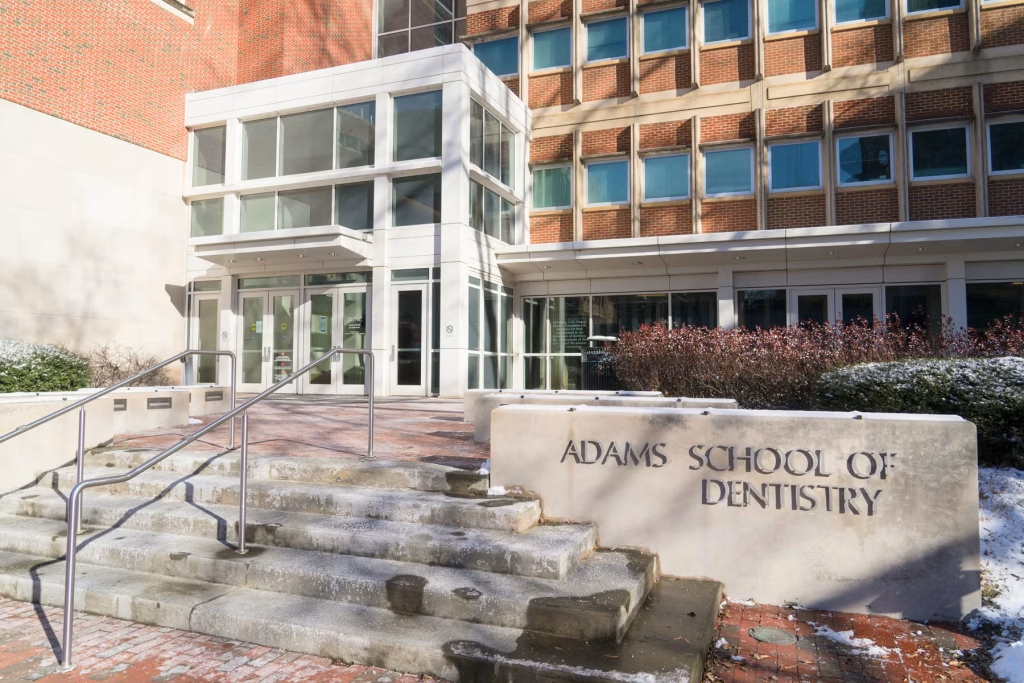
Otto, a UNC Chapel Hill graduate who grew up in Raleigh, further chronicled Deamonte’s life and death in the 2017 book Teeth: The Story of Beauty, Inequality, and the Struggle for Oral Health in America. Earlier this month, she returned to UNC as the keynote speaker at the Adams School of Dentistry graduation ceremony for 150 students earning degrees ranging from advanced dental education programs to doctors of dental surgery to dental hygiene.
Otto helped send the new degree holders into their next life chapter with words of hope and advice for them to keep looking for teachers along the way — whether they’re parents, children, colleagues, the powerful or powerless.

Public health advocacy
Her address comes when oral health care in North Carolina is still somewhat fragmented — with barriers similar to those that stymied the Driver family in Maryland. Many of the state’s dentists do not accept Medicaid patients because the reimbursement rate is still 34 cents on the dollar, the same that it was in 2008.
North Carolina is one of the nation’s most restrictive states for dental hygienist practice; each dentist can only supervise two hygienists, and the state requires direct on-site supervision except in some public health settings. Dental hygienists consistently fight to expand their scope of practice so they use their skills in more scenarios to improve access to preventative care..
Despite such obstacles, the UNC dental school has seen and fostered a growing interest among its students in public health dentistry.
“Public health has been a part of our history and a part of our curricula,” Janet Guthmiller, dean of the UNC dental school since October 2022, told NC Health News before the graduation ceremony. “I would say that now it’s more intentional, in terms of not just educating our students conceptually about what public health is, but really becoming advocates.”
There’s an enhanced focus on public health advocacy in coursework too.
For several years, the school has promoted the Advocate-Clinician-Thinker curriculum, which tries to inspire “a deep-rooted commitment to advocacy and critical thinking” so students can respond to a “rapidly evolving healthcare landscape.”

Some of that focus also includes coaching students on the whys and hows of being at the table when health care policy is crafted at the local, state and national levels.
The school recently launched the Program for Oral Health Policy, led by Zachary Brian, a former head of the NC Oral Health Collaborative who’s a dental school professor and director of the school’s Service to Community Program. The goal is to educate the students to “lead in policy advocacy, research and practice” to shape the future of oral health care.
The program helps get students placed in paid externships with state and national policymakers, associations and organizations, as well as gain experience in community health centers. The program’s core values include addressing systemic barriers that limit oral health access and engaging with communities to get a more diverse range of stakeholders into public policy development.
Vocal champions
Having that variety of voices help shape policy is important to addressing cultural barriers and highlighting the day-to-day impact of sometimes-byzantine rules and regulations, oral health advocates say.
Otto sat down in a dental school conference room before the UNC graduation with NC Health News and Weintraub, a researcher and clinician who has focused on public health dentistry for much of her career. The author talked about some of the non-dentists whose experiences and words spoke volumes during the reform efforts after Deamonte’s death.
Elijah Cummings, a lawyer from Maryland who served in the U.S. House of Representatives from 1996 until his death in 2019, grew up in modest circumstances in Baltimore with many barriers in his path.
“He would say quietly, ‘I thought dental pain was part of living when I was a child,’” Otto recalled. But, she added, “He was just a lion for this reform.”
Dennis Kucinich, a member of Congress from 1997 to 2013, also grew up in meager circumstances in Ohio, Otto recalled. He, too, remembered dental pain, she added.
“They took this personally in ways that they would not let it go,” Otto said.
Weeks after Barack Obama became president in 2009, he signed the Children’s Health Insurance Program Reauthorization Act, which turned dental coverage for children in the program from optional to required in every state.
In 2010, with the passage of the Affordable Care Act, pediatric dental services were classified as an “essential health benefit,” meaning all small-group and individual insurance plans — even private ones sold on the marketplace — included coverage for children’s oral health.
Progress and setbacks
As often is the case with reform efforts, though, it’s been one step forward and one step back.
“Under the Affordable Care Act, a lot of money was appropriated to Federally Qualified Health Centers and community health centers to add dental and mental health care to primary care services that they provide to at-risk communities,” Otto told NC Health News. “These were two important pieces of the primary care system that are usually not represented. This money helped them add these services.”
“Even in the darkest days of the pandemic, millions of dental visits were provided,” Otto added. “It’s not like they solved the whole problem or had enough providers — but there was momentum in that direction, and they were managing. They were demonstrating how dental and mental health could be part of primary care.”
For many years, oral health operated largely in a separate silo from the broader health care system. The insurance structure was different, which affected where providers were located and hurt access to care in rural and more impoverished areas.
Now, there’s a sharper focus on integrating oral health care with systemic physical health care to ensure better overall disease management, improve patient safety and even reduce healthcare costs.
New obstacles
A look into the mouth can reveal symptoms of diabetes, osteoporosis, heart disease and blood disorders. In some cases, poor gum and tooth health reveal signs of cognitive decline manifested in a lack of brushing and flossing.
But too often dentists in private practice are clustered in urban areas, leaving federally supported programs and community health centers as some of the main oral health care providers for people in underserved areas.
“Providers were thinking in terms of whole patient care,” Otto said. “They were in some cases, I guess doing warm handoffs to primary care providers and even a mental health provider.”
Then last year, many of those patients and leaders of infrastructure boosted by the Affordable Care Act learned of new obstacles taking shape. The One Big Beautiful Bill Act, signed into law July 4, 2025, makes major structural changes to Medicaid, which could eventually reduce access to oral health care.
“It imposes some very severe cuts on some of these same patients and the same infrastructure,” Otto said. “And so we’ll see.”
The making of a dentist
Some UNC dental students are contemplating work in some of those community clinics, but worry that salaries could fall short of what they need to pay down student loan debt that can top $200,000 in many cases.
Glory Olowojoba, a dental student from Atlanta, just wrapped up her first year on the Chapel Hill campus in her professional degree program. Public health dentistry is intriguing to her. She likes that she can earn a master’s degree in public health while fulfilling the requirements for her dental degree.
“There’s so much opportunity to learn about public health and be exposed to it,” she told NC Health News. “It’s embedded in our curriculum and the way we provide care here.”
Olowojoba became interested in dentistry because of the oral health problems she had as a child. By the time she was 16, she said, she had already had three root canals. “I really appreciated that the dentist took the time to explain to me what was going on.”
Like Olowojoba, Paige Carpenter, a dental student from Michigan, had a lot of dental work as a child. Unlike Olowojoba, though, Carpenter did not have a fondness for dentists.
“I just came from a rural area where dental education wasn’t great, so we did not realize the reason I was getting cavities was because of my sugar intake,” Carpenter told NC Health News. “So we kept doing the sugar, and I kept getting the cavities. It was just ‘Paige must have bad teeth.’”
While she was in college, though, studying chemistry, she started to look at job opportunities and shadowed a dentist to see whether dentistry would be a fit.. A patient came in with “almost every tooth cavitated,” in need of dentures. She marveled at how the dentist was “able to give him his mouth back” by offering a treatment plan.
“On that first day, just from what I saw, I was like ‘This is it, I’m in,’” Carpenter said.
Ryan Millan, a second year UNC dental school student from Greenville, felt a similar pull while shadowing his aunt, a dentist in Cleveland, Ohio. Both his parents are physicians, and although he liked the “health care aspect of being involved in people’s lives,” the prospect of being a physician wasn’t quite what he wanted.
He was in Durham, though, when he saw the chart for a baby in a general anesthesia case showing that every single tooth was being worked on. He related it to Otto’s story about Deamonte Driver.
“I think there’s a misconception that public health dentistry is its own specialty, which it is. But also, everyone can be involved in the public health aspect of it,” Millan said. “Some people are more involved in the advocacy aspects like going to lobbying day and meeting with the senators and representatives. It can also be shown in the clinical aspects of volunteering.”
“I think it’s important just to volunteer, like outreach,” Millan added. “It doesn’t have to be dental related, but a dentist volunteering.”
The post Giving more teeth to public health in dentistry appeared first on North Carolina Health News.